
Border Collie Weight Calculator — Free Puppy Growth Chart
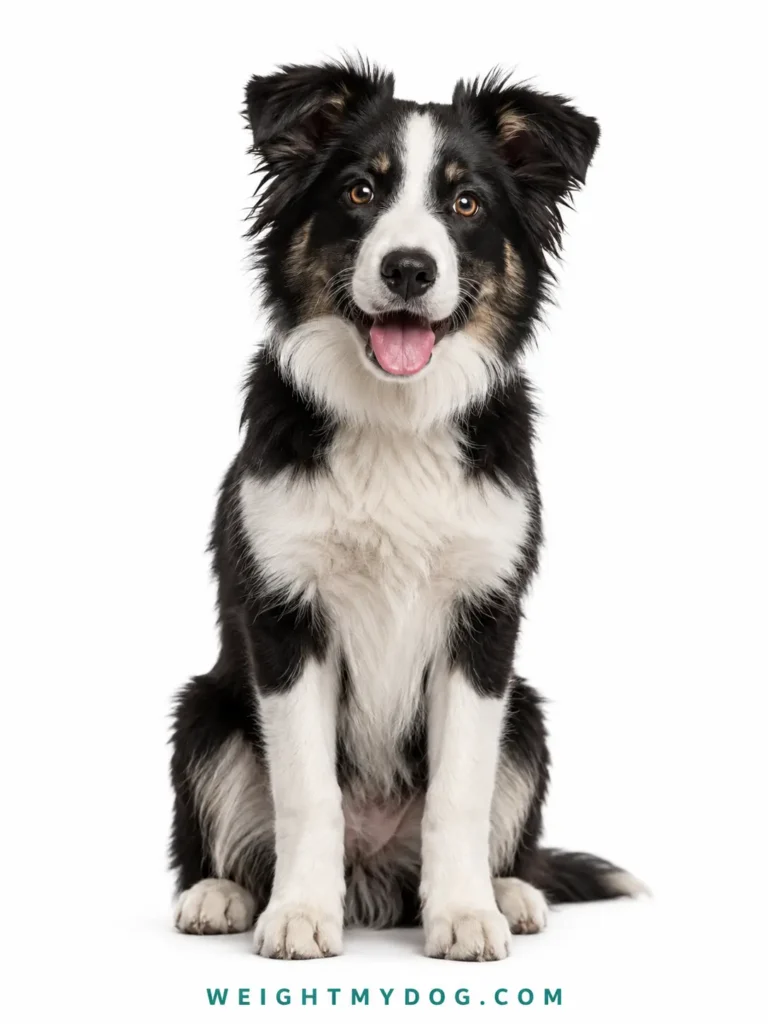
Border Collie owners often wonder whether their dog falls within a healthy weight range. Using a weight calculator removes guesswork entirely, giving you accurate data based on age, sex, and current weight to understand your dog’s development.
Most people don’t realize that Border Collies vary significantly across working-line and show-line types. These differences affect size, muscle mass, and body condition, making a one-size-fits-all approach unreliable for tracking your dog’s growth accurately.
A reliable puppy weight calculator uses veterinary growth curve data from sources like WALTHAM Petcare Science Institute and PLOS ONE to generate estimates. These tools pull from standardized growth charts and veterinary patient records spanning millions of purebred dogs globally.
Border Collie puppies grow at a constant rate during their first few months, then the growth rate gradually plateaus. Tracking this progression helps pet parents detect issues early, including underweight conditions, overfeeding risks, or delayed growth plate closure concerns.
I’ve personally tracked multiple Border Collie pups through developmental milestones, and the most telling signs come from body condition, not just pounds. A lean dog with visible ribs may look alarming but can be perfectly healthy depending on genetics and breed type.
Beyond numbers, mental stimulation matters as much as nutrition for a thriving high-energy breed. Border Collies need both daily exercise and cognitive challenges to maintain lean muscle, bone density, and an ideal body mass throughout every stage of life.
Border Collie Weight Calculator
| Age | ♂ Male (Expected) | ♀ Female (Expected) | Your Dog |
|---|
How to use the Border Collie weight calculator
Get your Border Collie's ideal weight in under 10 seconds. No account needed.
Enter your dog’s details
Enter your Border Collie's current age, weight, and gender. Works in both lbs and kg — supports weeks, months, and years.
Get your instant weight results
See your Border Collie's predicted adult weight range, current ideal weight, visual growth chart, and health status — instantly calculated.
Check your dog’s health status
Find out if your Border Collie is underweight, ideal, or overweight based on AKC-verified breed standards — and get a personalised feeding guide.
Male Border Collie Growth, Weight & Height Chart by Age
| Age | Male Weight | Male Height |
|---|---|---|
| 4 Weeks | 4 – 6 lbs (1.8 – 2.7 kg) | 4 – 6 in (10 – 15 cm) |
| 2 Months | 10 – 14 lbs (4.5 – 6.4 kg) | 7 – 9 in (18 – 23 cm) |
| 3 Months | 18 – 25 lbs (8.2 – 11.3 kg) | 10 – 13 in (25 – 33 cm) |
| 4 Months | 25 – 35 lbs (11.3 – 15.9 kg) | 13 – 16 in (33 – 41 cm) |
| 5 Months | 30 – 42 lbs (13.6 – 19.1 kg) | 15 – 18 in (38 – 46 cm) |
| 6 Months | 35 – 50 lbs (15.9 – 22.7 kg) | 17 – 20 in (43 – 51 cm) |
| 7 Months | 40 – 53 lbs (18.1 – 24.0 kg) | 18 – 21 in (46 – 53 cm) |
| 8 Months | 43 – 56 lbs (19.5 – 25.4 kg) | 19 – 22 in (48 – 56 cm) |
| 9 Months | 45 – 60 lbs (20.4 – 27.2 kg) | 20 – 23 in (51 – 58 cm) |
| 10 Months | 48 – 62 lbs (21.8 – 28.1 kg) | 21 – 23 in (53 – 58 cm) |
| 11 Months | 50 – 63 lbs (22.7 – 28.6 kg) | 21 – 24 in (53 – 61 cm) |
| 12 Months | 50 – 65 lbs (22.7 – 29.5 kg) | 22 – 24 in (56 – 61 cm) |
| 18 Months | 53 – 65 lbs (24.0 – 29.5 kg) | 22 – 24 in (56 – 61 cm) |
| 24 Months (Adult) | 55 – 65 lbs (24.9 – 29.5 kg) | 22 – 24 in (56 – 61 cm) |
Female Border Collie Growth, Weight & Height Chart by Age
| Age | Female Weight | Female Height |
|---|---|---|
| 4 Weeks | 3 – 5 lbs (1.4 – 2.3 kg) | 4 – 6 in (10 – 15 cm) |
| 2 Months | 8 – 12 lbs (3.6 – 5.4 kg) | 6 – 8 in (15 – 20 cm) |
| 3 Months | 15 – 22 lbs (6.8 – 10.0 kg) | 9 – 12 in (23 – 30 cm) |
| 4 Months | 20 – 30 lbs (9.1 – 13.6 kg) | 11 – 14 in (28 – 36 cm) |
| 5 Months | 25 – 37 lbs (11.3 – 16.8 kg) | 13 – 17 in (33 – 43 cm) |
| 6 Months | 28 – 42 lbs (12.7 – 19.1 kg) | 15 – 18 in (38 – 46 cm) |
| 7 Months | 32 – 45 lbs (14.5 – 20.4 kg) | 16 – 19 in (41 – 48 cm) |
| 8 Months | 35 – 48 lbs (15.9 – 21.8 kg) | 17 – 20 in (43 – 51 cm) |
| 9 Months | 37 – 50 lbs (16.8 – 22.7 kg) | 18 – 21 in (46 – 53 cm) |
| 10 Months | 38 – 52 lbs (17.2 – 23.6 kg) | 18 – 21 in (46 – 53 cm) |
| 11 Months | 40 – 53 lbs (18.1 – 24.0 kg) | 19 – 22 in (48 – 56 cm) |
| 12 Months | 40 – 55 lbs (18.1 – 24.9 kg) | 19 – 22 in (48 – 56 cm) |
| 18 Months | 42 – 55 lbs (19.1 – 24.9 kg) | 19 – 22 in (48 – 56 cm) |
| 24 Months (Adult) | 42 – 55 lbs (19.1 – 24.9 kg) | 19 – 22 in (48 – 56 cm) |
Puppy Growth Chart And AKC Breed Weight Standard
| Breed Size | 8 Weeks | 3 Months | 4 Months | 6 Months | 1 Year |
|---|---|---|---|---|---|
| Toy | 0.9 – 1.8 kg | 1.4 – 2 kg | 2 – 2.5 kg | 2.5 – 3 kg | 3 – 5.5 kg |
| Small | 1.5 – 3 kg | 3 – 5 kg | 4 – 7 kg | 6 – 9 kg | 6 – 11 kg |
| Medium | 3 – 5 kg | 5 – 8 kg | 8 – 13 kg | 10 – 18 kg | 11 – 23 kg |
| Large | 5 – 9 kg | 9 – 12 kg | 12 – 20 kg | 18 – 30 kg | 23 – 45 kg |
| Giant | 7 – 12 kg | 12 – 18 kg | 18 – 28 kg | 28 – 40 kg | 45 – 70 kg |
Border Collie Size Overview
Border Collies are classified as a medium breed, sitting comfortably within the medium breeds size spectrum. They aren’t as compact as a Corgi or as towering as a Great Dane, yet they carry a distinctly aerodynamic build built for herding.
Male dogs typically measure 18 to 22 inches in height, while female dogs tend to be marginally taller or shorter depending on genetics. Both adult male and adult female dogs display a lean, muscular physique suited to working dogs across Scotland and England.
The Anglo-Scottish border region gave this breed its identity. Ancestors like Old Hemp, a celebrated sheepdog and stud, shaped the Border Collie’s aerodynamic frame, narrow chest, lean build, and agility — traits that remain visible even in modern show dogs.
Border Collie Weight: What’s Normal?
Understanding what’s normal for a Border Collie starts with recognizing their medium-sized dogs classification. An adult dog shouldn’t look square or broader than their height suggests — a slight tuck up at the waist and belly indicates ideal body condition.
AKC breed weight standards define the healthy range for this breed. However, working-line Border Collies often fall at the leaner end while show-line dogs may appear heavier. Neither is wrong — genetics, diet, and exercise all shape the adult weight meaningfully.
Veterinary research confirms that Border Collies with consistent bodyweight monitoring live longer. Dogs that are overweight or obese face risks including hip dysplasia, cardiac disease, and organ failure, while lean dogs consistently demonstrate greater longevity and long-term health outcomes.
Weight gain that accelerates beyond normal growth rate benchmarks signals overfeeding. Conversely, rapid weight loss in a growing pup may point toward underfeeding or neurological conditions. Both extreme deviations deserve prompt veterinary guidance from a qualified veterinarian.
A healthy Border Collie should have ribs you can feel with light pressure but not see sharply. The chest should be narrow and angular, legs tall and lean, with no excess weight pooling around the belly or waist area.
Many Border Collie owners mistakenly compare their dog’s weight against Labradors, German Shepherds, or Boxers — all much heavier large breeds. Instead, compare against AKC breed standards that reflect the medium breed build designed for herding, agility, and obedience.
Male Border Collie
Male Border Collie puppies grow into adults typically weighing between 30 and 55 lbs, with male weight peaking around 18 months. Male dogs tend to be slightly taller, reaching adult height of up to 22 inches.
Adult male Border Collies benefit from structured exercise including long runs, herding trials, and agility courses. Their muscular physique and high energy levels require daily vigorous activity to maintain lean muscle and avoid weight gain from inactivity.
At 12 months, most male dogs reach full height, though muscle mass continues filling out until 18 months. Male height and male weight both stabilize by then, marking full maturity for the average adult male Border Collie.
Female Border Collie
Female Border Collies typically weigh between 25 and 45 lbs at full size. Female weight averages slightly below male weight, and female height usually caps around 19 to 21 inches depending on genetics and litter size.
Spayed females and intact females show different metabolic changes post-procedure. Spayed dogs may experience weight gain if nutrition and exercise aren’t adjusted after spaying. Monitoring female weight and body condition regularly becomes especially important following the spay procedure.
Female counterparts often outlive males by 1 to 2 years, a trend supported by veterinary research. Spayed females who maintain ideal weight and receive consistent veterinary care tend to be among the longest-lived Border Collies, often reaching 15 or more years.
How Big Should a 6-Month-Old Border Collie Be?
At six months, a Border Collie puppy enters a critical growth period where growth rate remains rapid but begins preparing to slow. A six-month-old Border Collie typically weighs between 15 and 25 pounds, depending on sex and genetics.
Male pups at six months often weigh closer to 20 to 25 lbs, while females typically sit around 15 to 20 lbs. These estimates align with AKC breed standard projections and WALTHAM charts used by veterinarians for weight assessment.
During this growth phase, oversized paws are completely normal. Large paw size relative to body size is a reliable signal of remaining growth ahead. Border Collie puppies with notably large paws at six months haven’t yet reached adult size or full height.
When Does a Border Collie Stop Growing?
Most Border Collies stop growing in height between 12 and 15 months. However, body weight and muscle mass continue developing until around 18 months, when growth plate closure signals the end of skeletal development for the breed.
Giant breeds like Mastiffs and Great Danes take far longer — up to 24 months — to reach full size. In contrast, Border Collies as medium breeds reach adult height faster, making growth charts useful for predicting estimated final size with reasonable accuracy.
Growth plates in Border Collies typically close by 12 to 14 months in females and 14 to 16 months in males. After growth plate closure, height growth effectively stops, though body condition continues evolving with nutrition and exercise habits.
Working-line Border Collies may appear to grow slightly longer due to muscle development driven by vigorous exercise and herding work. Their leaner build means weight may keep fluctuateing post-maturity based on activity and diet rather than true growth.
Show-line dogs tend to reach full maturity earlier, with growth stabilizing closer to 12 months. Their heavier build and broader frame mean body mass feels more stable sooner compared to their working-line counterparts who remain leaner and more energetic.
Understanding when a Border Collie stops growing matters for exercise planning. Repetitive high-impact exercise like jumping or stairs climbing should be limited during the growth phase to reduce joint risk and joint damage before growth plates fully close.
How to Use the Calculator
The Puppy Weight Predictor Calculator is straightforward. Enter your Border Collie’s current weight, age in months, and sex. Hit the calculate button, and the tool generates an estimated weight alongside an expected adult weight using veterinary growth curve data.
Input fields typically request breed, sex, spay status, and current weight in either lbs or kg. For mixed-breed puppies, select the closest breed mix or enter parent sizes if known. DNA testing can also help refine the breed inputs for more accurate outputs.
The calculator’s outputs provide an estimated final size, expected adulthood weight, and adult size projection. Always cross-reference these estimates with your veterinarian and standardized growth charts from sources like the Journal of Veterinary Internal Medicine for clinical confirmation.
How Much Bigger Will My Border Collie Get?
The percentage-of-adult-weight method is one reliable approach. At 16 weeks, a puppy typically represents around 40 to 50 percent of their total adult body weight. Dividing current weight by this percent gives a rough maximum size estimate.
Border Collie puppies at 12 weeks typically weigh around 8 to 10 lbs. By 6 months, that weight roughly doubles, and by 12 months, most Border Collies are near their adult weight within 10 to 15 percent variance.
Larger Border Collies from large parent breeds in their mixed-breed range may reach 55 lbs, while smaller breeds crossed with Border Collies might yield adults closer to 25 to 30 lbs. The largest parent is the most reliable size predictor available.
Growth slows significantly after 12 months, with most weight gain after this point coming from muscle mass rather than bone development. Border Collies in working lines may pack on lean weight post-maturity from sheepherding and herding exercise programs.
Checking growth chart data against specific ages helps predict how much bigger a pup will get. Tools referencing WALTHAM growth curve data or AKC adult ideal weight range give the most accurate prediction for individual Border Collie development.
Genetics from both parents influence estimated adulthood weight most. A Border Collie crossed with an Australian Cattle Dog or Kelpie may be leaner, while one crossed with a Labrador or Golden Retriever often lands heavier — so breed mix details genuinely matter.
Working Line vs Show Line — Size Difference
Working-line Border Collies are typically leaner, lighter, and more aerodynamic than their show-line counterparts. Their bodies are built for agility, endurance, and herding instincts — not conformation judging under AKC conformation standards.
Show-line dogs bred to meet Official Border Collie Breed Standards tend to be broader, with more muscle mass and a heavier build. They’re often taller and heavier than working-line dogs, reflecting aesthetic standards over functional herding abilities.
The size difference between working lines and show lines is real and well-documented in veterinary growth research. Working-line Border Collies bred for herding trials and sheep herding average 5 to 10 lbs lighter than show dogs at adult size.
Body Condition Check
A body condition check involves assessing the ribcage, waist, chest, and belly visually and through touch. Lean dogs with a tuck up at the waist and ribs detectable under light pressure typically fall within the ideal weight range.
Overweight dogs show excess weight around the belly, loss of waist definition, and ribs buried under fat. Obese Border Collies face increased risks of hip dysplasia, cardiovascular disease, hemangiosarcoma, osteosarcoma, and cancer, significantly reducing expected lifespan.
Underweight Border Collies display visible ribs, angular legs, a hollow belly, and no lean muscle coverage. These dogs require immediate veterinary care, adjusted nutrition, and diet changes. Bodyweight monitoring twice daily may be recommended during recovery phases.
Key Weight Characteristics to observe include lean muscle tone, chest depth, rib spacing, and waist prominence. A thriving Border Collie at adult size carries a square body proportion without looking broader or heavier than their breed standard indicates.
Body condition directly correlates with longevity and long-term health. Border Collies consistently held within their healthy weight range demonstrate stronger immune response, reduced cardiac disease incidence, and better mobility throughout their years as adults.
Veterinarians use a 1 to 9 body condition scale to assess a Border Collie’s health status accurately. Scores between 4 and 5 represent ideal weight, while scores of 7 or above signal overweight conditions requiring immediate diet and exercise intervention.
Key Weight Characteristics
Border Collies maintain lean bodies characterized by visible muscle tone, narrow chests, and a natural tuck up at the waist. These key physical traits distinguish them from larger breeds and confirm healthy body condition at adult size.
Lean muscle and bone density are among the most critical weight characteristics in this breed. A well-conditioned Border Collie feels firm and aerodynamic, with legs tall relative to body and coats that reflect nutrition quality and health status.
Temperament and energy levels often mirror body condition. A Border Collie at ideal weight typically displays its natural eagerness to please, intelligence, and high-energy behavior patterns. Excess weight dulls these traits, making weight assessment part of behavioral health checks.
How Long Do Border Collies Live?
Border Collies are among the longest-lived medium breeds, with an average lifespan of 12 to 15 years. Some healthy individuals from strong genetics backgrounds have exceeded 17 or even 18 years, setting remarkable world records in canine longevity.
Genetics, nutrition, exercise, and veterinary care all directly influence expected lifespan. Working dogs who remain active through herding activities and receive daily mental stimulation often outlive sedentary counterparts by 2 to 3 years on average.
Cardiac disease, cancer, hemangiosarcoma, osteosarcoma, Collie Eye Anomaly, and hip dysplasia are the most common causes of reduced lifespan in Border Collies. Annual veterinary guidance and early diagnosis can delay or manage many of these health conditions effectively.
Females statistically outlive males by approximately 1 to 2 years. Spayed females who maintain ideal weight and receive breed-specific care tend to live the longest. Intact females face higher cancer risks, while neutered males show different metabolic changes affecting body mass.
Scotland and England’s sheepdog tradition produced a breed with remarkable vitality. Border Collies descended from ancestors bred for endurance carry genetics that support vibrant aging — particularly when diet, exercise, and socialization remain consistent across years.
Longevity in this breed is closely tied to body condition management across all stages of life. Border Collies kept at healthy weight, given structured exercise, and enriched with mental stimulation consistently demonstrate the longest-lived profiles in medium breed veterinary research.
Estimated Border Collie Lifespan by Body Condition
Body condition scores directly predict estimated lifespan. A Border Collie scoring 4–5 on the veterinarian scale typically achieves 12–15 years, while obese dogs scoring 7–9 often face organ failure, cardiac disease, and significantly reduced longevity.
Lean dogs scoring 3–4 who maintain lean muscle and bone density through active herding, agility, or structured exercise programs frequently reach 15 or more years. Their aerodynamic build and high energy levels naturally resist cardiovascular disease accumulation over time.
Overweight Border Collies typically show growth stalls in vitality and energy by age 8–10 years old. Managing nutrition and enforcing daily vigorous activity from puppyhood gives the best foundation for achieving the upper end of this breed’s expected lifespan.
The 5-Minute Rule for Puppies
The 5-minute rule is a veterinary guidance standard recommending 5 minutes of structured exercise per month of age, applied twice daily. A 3-month-old Border Collie puppy should receive no more than 15 minutes of exercise per session.
Repetitive high-impact exercise including jumping, climbing stairs, and long runs before growth plate closure causes serious joint damage. Forced exercise on growing puppies risks joint risk complications that may require veterinary care well into adulthood, permanently affecting adult size potential.
Free play is different from forced exercise. Puppies self-regulate during free play, naturally avoiding excessive impact on developing bones. Structured exercise beyond the 5-minute rule threshold should never be imposed on Border Collie puppies before 12 months of age.
Factors Affecting Size
Genetics from both parents represent the most significant factor affecting a Border Collie’s adult size. If the largest parent weighed 55 lbs, the puppy will likely approach that weight. Parent sizes provide the most reliable maximum size estimate available.
Nutrition quality and feeding frequency during the first few months shape growth rate significantly. Underfeeding causes delayed growth plate closure and stunted adult height, while overfeeding accelerates weight gain beyond ideal weight, risking hip dysplasia and cardiovascular disease long-term.
Sex plays a measurable role in size. Males consistently reach taller adult height and heavier adult weight than females. Neutered males and spayed females show metabolic changes that affect body mass if nutrition isn’t adjusted post-procedure.
Litter size affects individual puppy development. Puppies from smaller litters often receive more nutrition in the womb, resulting in larger birth weight and potentially heavier adult weight. Individual puppies from large litters may be lighter at birth but catch up during the growth phase.
Health status and presence of neurological conditions or cardiac disease can slow growth. A puppy diagnosed early with Collie Eye Anomaly or hip dysplasia may develop differently in size and body condition than a healthy peer from the same litter.
Exercise type and training regimen affect muscle mass development. Working-line Border Collies engaged in daily herding, agility, and obedience training develop denser lean muscle than show-line dogs. This muscle mass accounts for meaningful weight differences even between dogs of similar height.
How We Predict Puppy Weight / Methodology
Our puppy weight calculator uses the percentage-of-adult-weight method cross-referenced with veterinary growth curve data from WALTHAM Petcare Science Institute and PLOS ONE. These standardized growth charts analyze millions of purebred dogs to build reliable prediction models.
Breed, sex, spay status, and current weight at a specific age feed into the algorithm. The tool compares your Border Collie’s growth curve data against the average curve for medium breeds, producing an estimated final size with AKC adult weight benchmarks embedded.
Veterinary patient records and litter size data from 2017 studies in the Journal of Veterinary Internal Medicine help refine outputs. The breed list includes dominant breeds like Labrador, Golden Retriever, German Shepherd, Beagle, and Australian Shepherds, ensuring Border Collie estimates aren’t skewed by giant breeds or toy breeds data.
The methodology applies growth rate corrections for neutered versus intact status, as spayed dogs and neutered dogs demonstrate different metabolic changes affecting adult weight. Spay status alone can shift estimated weight by up to 5 percent in female Border Collies.
Deviations from the average curve are flagged as extreme deviations when a puppy’s growth rate falls outside 2 standard deviations of the breed norm. These flags prompt veterinarian review to rule out underfeeding, overfeeding, or underlying health conditions affecting development.
DNA testing increasingly supports methodology refinement for mixed breed puppies. By identifying the dominant breed and breed 2 contributors, the Puppy Weight Predictor Calculator can apply breed-specific growth charts and generate more accurate expected adulthood weight outputs for mixed-breed puppies.
Understanding Puppy Growth Patterns
Border Collie puppies follow a growth curve that accelerates rapidly in the first few months before growth slows around 6 to 8 months. This critical growth period is marked by weekly weight gain in pounds per week that can feel dramatic to new pet parents.
Growth rate isn’t linear — it follows a curve that mimics other medium breeds like the Bearded Collie, Australian Cattle Dog, and Kelpie. Early rapid growth followed by plateaus and growth stalls is normal and shouldn’t alarm breeders or pet parents.
Between 3 and 6 months, Border Collie puppies are in their most energetic adolescent feature phase. Behaviors like nipping, chasing, and herding instincts emerge alongside weight gain and height growth, reflecting working origins deeply embedded in the breed’s genetics.
Growth chart data shows that male dogs and female dogs follow different growth patterns from as early as 8 weeks. Males consistently gain more weight per month through 12 months, after which growth rate narrows between the genders as both approach full size.
Mixed-breed puppies with Border Collie heritage follow mixed-breed range growth patterns influenced by the dominant breed. Without DNA testing, the breed mix can be unpredictable, making the puppy growth calculator most effective when parent sizes are known and entered accurately.
Structured exercise affects growth patterns beyond just body condition. Puppies who receive appropriate daily free play without forced exercise develop healthier growth plates, stronger bone density, and better lean muscle distribution — setting the foundation for thriving adult size development.
Border Collie Breed Classification
Border Collies are classified within the herding breed group by the American Kennel Club. This breed group designation reflects the breed’s deep working origins in sheep herding across the Anglo-Scottish border region spanning Scotland and England.
The AKC breed standard places Border Collies in the medium breed size category, distinct from both small breeds and large breeds. Their breed classification also includes traits like intelligence, eagerness to please, socialization ability, and obedience — not just size categories.
Border Collies have appeared in television shows, films, and Scottish poetry, reflecting their cultural prominence beyond herding trials. Queen Victoria famously owned sheepdogs of this breed, helping elevate the Border Collie from a working-line farm dog to a celebrated breed globally.
Frequently Asked Questions — Border Collie Weight
How Accurate Is a Puppy Weight Calculator?
Puppy weight calculators using WALTHAM Petcare Science Institute data and veterinary growth curve data are typically accurate within 10 to 15 percent for purebred dogs. Accuracy depends on the quality of current weight, age, sex, and breed inputs provided.
Mixed breed pups show wider variation because breed mix and dominant breed influence growth rate unpredictably. For the best prediction, supply parent sizes, spay status, and DNA testing results when available to generate the most reliable estimated final size output.
How Big Will My Puppy Get?
Border Collie puppies grow to adult size between 30 and 55 lbs depending on sex, genetics, and working-line or show-line classification. Males typically reach the upper end of the AKC adult ideal weight range, while females remain toward the lighter side.
Using the percentage-of-adult-weight method at 16 weeks gives a reliable estimate. Multiply the current weight by 2 or apply the puppy growth calculator inputs for a more refined expected adulthood weight aligned with AKC breed weight standards for this high-energy breed.
When Do Puppies Stop Growing?
Border Collies stop growing in height by 12 to 15 months and in body mass by 18 months. Giant breeds take up to 24 months, while toy breeds finish growing by 10 months, making medium breeds like Border Collies fall exactly in the middle of the spectrum.
Growth plate closure between 12 and 16 months marks the physiological end of height growth. After this, weight may still fluctuate as muscle mass develops from exercise and herding activities, particularly in working-line Border Collies who remain active well into adulthood.
Does Neutering or Spaying Affect My Puppy’s Adult Weight?
Neutering and spaying trigger metabolic changes that can increase weight gain in Border Collies if diet and exercise aren’t adjusted. Neutered males and spayed females typically gain 5 to 10 percent more body mass post-procedure without dietary modifications.
Spayed dogs may also experience delayed growth plate closure, meaning they grow taller but potentially leaner than intact females. Monitor body condition regularly after the neuter or spay procedure and consult your veterinarian to recalibrate nutrition and maintain ideal weight long-term.
What If My Puppy Is a Mixed Breed?
Mixed breed puppies with Border Collie heritage inherit size traits from both parents. The largest parent typically indicates the maximum size estimate for the mixed breed pup. DNA testing can confirm breed mix and refine expected adulthood weight projections accurately.
For a Chihuahua-Border Collie cross versus a Mastiff-Border Collie cross, adult weight could range from 10 to 65 lbs — a wide range reflecting the mixed-breed range variability. Always use parent sizes and current weight as primary inputs for any puppy weight calculator.
Why Is My Puppy’s Growth Different from the Chart?
Individual Border Collie puppies naturally deviate from standardized growth charts due to genetics, litter size, nutrition, and health status. Minor deviations are normal; only extreme deviations — more than 2 standard deviations from the average curve — warrant veterinary guidance.
Growth chart data represents average growth rate across millions of purebred dogs and doesn’t account for every individual factor. A Border Collie with working-line genetics may track leaner than the chart predicts, which is perfectly healthy for their breed type and activity level.
How Big Should a 6-Month-Old Border Collie Be?
A six-month-old Border Collie should weigh approximately 15 to 25 pounds based on sex and genetics. Male dogs typically hit the 20 to 25 lb range, while female Border Collies usually weigh between 15 and 20 lbs at six months.
Oversized paws at six months are a healthy and normal indicator of remaining growth. Paw size relative to body is a reliable prediction marker. If your Border Collie pup still has notably large paws, expect continued growth through 12 to 15 months of age.
At What Age Is a Border Collie Fully Grown?
Border Collies are considered fully grown in height by 12 to 15 months of age. However, full maturity — including muscle mass, body condition, and adult weight — isn’t typically reached until 18 months for most males and females across both working-line and show-line types.
Some Border Collies from working lines continue filling out until their first birthday passes and growth slows naturally. Veterinary growth research confirms that growth plate closure and full size differ by as much as 6 months between early-maturing show-line dogs and slower-maturing working-line Border Collies.
What Is the Size of a Full-Grown Border Collie?
A full-grown Border Collie typically stands 18 to 22 inches tall and weighs between 30 and 55 lbs. Adult male dogs reach the taller and heavier end, while adult female Border Collies are generally lighter and marginally taller only in rare cases of exceptional genetics.
The AKC adult weight range confirms 30–55 lbs as the healthy weight range for this medium-sized breed. Full-grown Border Collies in working lines may be leaner and lighter, while show-line adults often weigh closer to the upper end of the AKC adult ideal weight range.
How Much Bigger Will My Border Collie Get?
If your Border Collie is under 12 months, they are still growing. Use the percentage-of-adult-weight method: at 16 weeks, multiply current weight by 2 for a rough estimate. The puppy weight calculator refines this further using breed, sex, and growth curve data.
Growth slows considerably after 12 months, with the final 5 to 10 percent of adult weight added through muscle mass rather than bone development. Your Border Collie will likely reach full size by 18 months, after which weight should remain stable with consistent nutrition and exercise.
Table of Contents
Toggle