
Italian Greyhound Weight Calculator — Free Puppy & Dog Growth Chart by Age
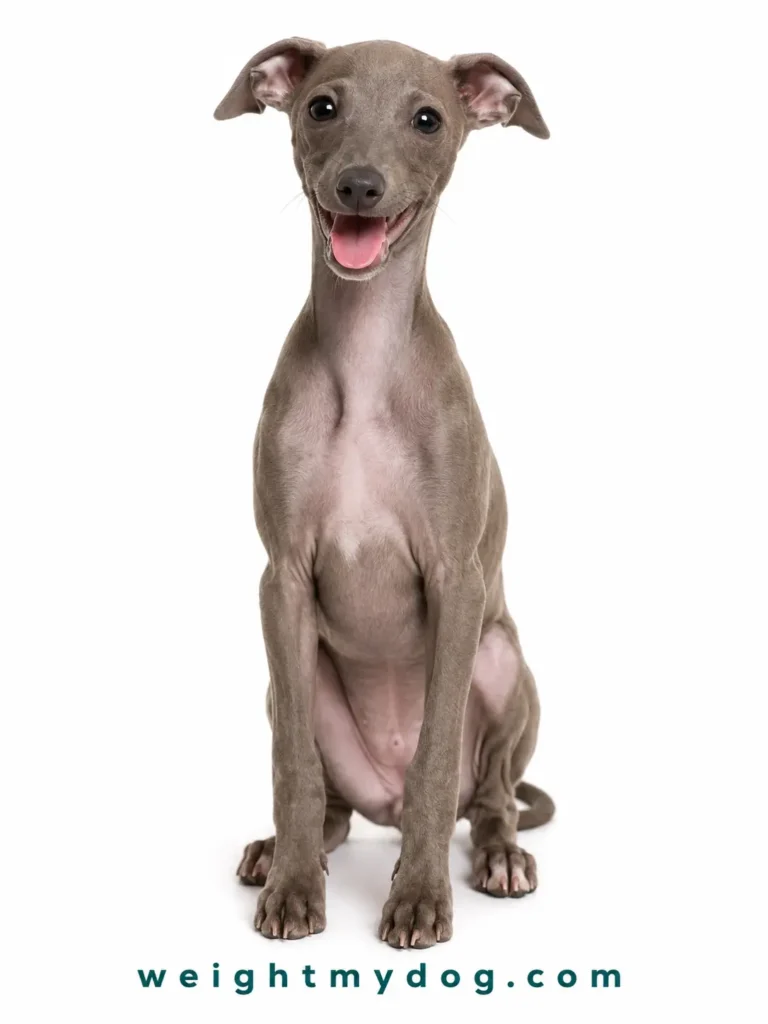
The Italian Greyhound is an ancient, elegant, sighthound with slender limbs, a thin coat, and a fine bone structure built for speed. This toy breed has been cherished for centuries, originating from the Mediterranean and refined into the graceful companion we know today.
Italian Greyhounds possess a svelte, aerodynamic build that separates them from medium dogs and large breeds entirely. Their delicate bone density and agile frame make them uniquely proportioned, requiring owners to understand breed standards and healthy weight expectations before bringing one home.
Classified under the toy group by the American Kennel Club, this breed weighs between 7 lb 11 oz and 14 lbs at full height. Understanding breed-specific data helps owners compare their dog against AKC breed standards to ensure good health and normal development.
The Italian Hound lineage is fast, playful, and naturally active. These are competitor-level athlete dogs that require physical stimulation, mental stimulation, and regular exercise despite their small stature and lap dog tendencies in cooler months.
Their constitution is notably fragile, meaning bone injuries, fractures, and broken legs are genuine risks. As a small-breed sighthound, the Italian Greyhound demands careful supervision, especially around furniture, slippery surfaces, and roughhousing with larger dogs.
Breed size, gender, genetics, and diet all contribute to the growth trajectory of every individual. Whether you’re tracking a puppy or a mature adult, knowing the weight range and height benchmarks for this toy breed sets the foundation for responsible ownership.
Italian Greyhound Weight Calculator
| Age | ♂ Male (Expected) | ♀ Female (Expected) | Your Dog |
|---|
How to use the Italian Greyhound Weight Calculator
Get your Italian Greyhound's ideal weight in under 10 seconds. No account needed.
Enter your dog’s details
Enter your Italian Greyhound's current age, weight, and gender. Works in both lbs and kg — supports weeks, months, and years.
Get your instant weight results
See your Italian Greyhound's predicted adult weight range, current ideal weight, visual growth chart, and health status — instantly calculated.
Check your dog’s health status
Find out if your Italian Greyhound is underweight, ideal, or overweight based on - verified breed standards — and get a personalised feeding guide.
Male Italian Greyhound Growth, Weight and Height Chart by Age
| Age | Male Weight | Male Height |
|---|---|---|
| 4 Weeks (1 Month) | 0.5 – 1 lbs (0.23 – 0.45 kg) | 2 – 4 in (5.1 – 10.2 cm) |
| 2 Months (8 Weeks) | 1 – 2.5 lbs (0.45 – 1.13 kg) | 4 – 6 in (10.2 – 15.2 cm) |
| 3 Months | 2 – 4 lbs (0.91 – 1.81 kg) | 6 – 8 in (15.2 – 20.3 cm) |
| 4 Months | 3 – 6 lbs (1.36 – 2.72 kg) | 7 – 10 in (17.8 – 25.4 cm) |
| 5 Months | 5 – 8 lbs (2.27 – 3.63 kg) | 9 – 11 in (22.9 – 27.9 cm) |
| 6 Months | 6 – 10 lbs (2.72 – 4.54 kg) | 10 – 12 in (25.4 – 30.5 cm) |
| 7 Months | 7 – 11 lbs (3.18 – 4.99 kg) | 11 – 13 in (27.9 – 33.0 cm) |
| 8 Months | 8 – 12 lbs (3.63 – 5.44 kg) | 12 – 13 in (30.5 – 33.0 cm) |
| 9 Months | 9 – 13 lbs (4.08 – 5.90 kg) | 12 – 14 in (30.5 – 35.6 cm) |
| 10 Months | 10 – 13 lbs (4.54 – 5.90 kg) | 13 – 14 in (33.0 – 35.6 cm) |
| 11 Months | 10 – 14 lbs (4.54 – 6.35 kg) | 13 – 14 in (33.0 – 35.6 cm) |
| 12 Months | 11 – 14 lbs (4.99 – 6.35 kg) | 13 – 15 in (33.0 – 38.1 cm) |
| 18 Months (Adult) | 11 – 15 lbs (4.99 – 6.80 kg) | 13 – 15 in (33.0 – 38.1 cm) |
| 24 Months (Full Grown) | 7 – 14 lbs (3.18 – 6.35 kg) | 13 – 15 in (33.0 – 38.1 cm) |
Female Italian Greyhound Growth, Weight and Height Chart by Age
| Age | Female Weight | Female Height |
|---|---|---|
| 4 Weeks (1 Month) | 0.4 – 0.9 lbs (0.18 – 0.41 kg) | 2 – 3 in (5.1 – 7.6 cm) |
| 2 Months (8 Weeks) | 0.9 – 2 lbs (0.41 – 0.91 kg) | 3 – 5 in (7.6 – 12.7 cm) |
| 3 Months | 1.5 – 3.5 lbs (0.68 – 1.59 kg) | 5 – 7 in (12.7 – 17.8 cm) |
| 4 Months | 2.5 – 5 lbs (1.13 – 2.27 kg) | 6 – 9 in (15.2 – 22.9 cm) |
| 5 Months | 4 – 7 lbs (1.81 – 3.18 kg) | 8 – 11 in (20.3 – 27.9 cm) |
| 6 Months | 5 – 9 lbs (2.27 – 4.08 kg) | 10 – 12 in (25.4 – 30.5 cm) |
| 7 Months | 6 – 10 lbs (2.72 – 4.54 kg) | 11 – 13 in (27.9 – 33.0 cm) |
| 8 Months | 7 – 11 lbs (3.18 – 4.99 kg) | 11 – 13 in (27.9 – 33.0 cm) |
| 9 Months | 7 – 12 lbs (3.18 – 5.44 kg) | 12 – 14 in (30.5 – 35.6 cm) |
| 10 Months | 8 – 12 lbs (3.63 – 5.44 kg) | 12 – 14 in (30.5 – 35.6 cm) |
| 11 Months | 8 – 13 lbs (3.63 – 5.90 kg) | 12 – 14 in (30.5 – 35.6 cm) |
| 12 Months | 8 – 13 lbs (3.63 – 5.90 kg) | 13 – 15 in (33.0 – 38.1 cm) |
| 18 Months (Adult) | 7 – 14 lbs (3.18 – 6.35 kg) | 13 – 15 in (33.0 – 38.1 cm) |
| 24 Months (Full Grown) | 7 – 13 lbs (3.18 – 5.90 kg) | 13 – 15 in (33.0 – 38.1 cm) |
Puppy Growth Chart And Official AKC Breed Weight Standard
| Breed Size | 8 Weeks | 3 Months | 4 Months | 6 Months | 1 Year |
|---|---|---|---|---|---|
| Toy | 0.9 – 1.8 kg | 1.4 – 2 kg | 2 – 2.5 kg | 2.5 – 3 kg | 3 – 5.5 kg |
| Small | 1.5 – 3 kg | 3 – 5 kg | 4 – 7 kg | 6 – 9 kg | 6 – 11 kg |
| Medium | 3 – 5 kg | 5 – 8 kg | 8 – 13 kg | 10 – 18 kg | 11 – 23 kg |
| Large | 5 – 9 kg | 9 – 12 kg | 12 – 20 kg | 18 – 30 kg | 23 – 45 kg |
| Giant | 7 – 12 kg | 12 – 18 kg | 18 – 28 kg | 28 – 40 kg | 45 – 70 kg |
When Do Italian Greyhounds Stop Growing?
Most Italian Greyhounds reach physical maturity somewhere between 12 months and 18 months of age. Unlike giant breeds or large breeds, this small breed completes its final growth phase relatively quickly, with bone development largely finished by the 1 year mark.
The growth rate slows down significantly after 6 months, though muscle development and body fat distribution may continue through 24 months. Some males may fill out slightly past 12 months, particularly in muscle mass and stature, before reaching full size.
By 2 years, the vast majority of Italian Greyhounds have reached adult size. However, hormonal development tied to spaying, neutering, or desexing can affect timing, and veterinarians often recommend monitoring weight through 36 months for full-grown confirmation.
How Much Should a 6-Month-Old Italian Greyhound Weigh?
At 6 months, an Italian Greyhound puppy typically weighs between 3.6 kg and 4.5 kg, which translates to roughly 8 lbs to 10 lbs. This places most pups near the lower end of their expected adult weight and indicates the growth is slowing down from its earlier rapid growth phase.
A female at six months may trend slightly lighter than a male, reflecting natural size difference between female dogs and male dogs of this breed. Comparing against breed averages and breed growth charts at this stage helps flag any developmental problems early.
Using a puppy weight calculator at 6 months gives a rough indicator of expected adulthood weight. Most online calculators factor in current weight, current age, and gender to produce a predicted range that aligns with AKC adult ideal weight range benchmarks.
What Is the Ideal Weight for an Italian Greyhound?
The ideal weight for a fully mature Italian Greyhound falls between 3.6 kg and 6.4 kg, or approximately 8 lbs to 14 lbs according to AKC breed standards. Males tend toward the heavier end while females typically remain lighter, though individual variations exist across lineage and breed group.
AKC adult weight expectations are not rigid absolutes — body condition, muscle tone, and bone structure matter as much as raw numbers on a scale. A dog at 5.4 kg with visible ribs may be underweight, while another at 6.4 kg with solid muscle mass is perfectly healthy.
Reaching and maintaining an ideal weight requires consistent attention to feeding schedule, diet, and exercise levels throughout the dog’s life span. The average adult weight range reflects breed standards, but each dog’s constitution and genetics define what healthy weight truly means for them.
Puppy Growth Stages Explained
Newborn to 8 Weeks (Rapid Growth)
From birth to 8 weeks, Italian Greyhound puppies undergo a rapid growth phase unlike any other period in their lives. Newborn pups typically weigh just 0.2 kg and can reach close to 0.9 kg by the end of first week, showing how explosive early development truly is.
During this stage, nutrition comes entirely from the mother, whose milk supplies all essential nutrients, vitamins, proteins, and fats needed for bone development and muscle formation. Puppy formula may supplement feeding if the mother cannot nurse adequately.
The rapid growth between 0 months and 8 weeks sets the foundation for healthy growth later. Newborn weight nearly quadruples within this window, and any developmental problems at this stage — caused by parasites, worms, or undernutrition — can have lasting effects on adult size.
2–6 Months (Major Size Changes)
The 2–6 months window delivers the most major size changes an Italian Greyhound puppy will ever experience. From roughly 1.4 kg at 2 months, a pup can reach 4.1 kg or more by 4 months, showing noticeable growth in both height and weight almost weekly.
- 1 month: approximately 0.5 kg to 1.0 kg
- 2 months: approximately 1.4 kg to 1.8 kg
- 3 months: approximately 2.2 kg to 2.9 kg
- 4 months: approximately 3.2 kg to 4.1 kg
- 6 months: approximately 3.6 kg to 4.5 kg
Feeding schedules during this period should prioritize high-quality puppy food with strong protein content. Small meals fed twice a day help regulate blood sugar drops and hypoglycemia — a real risk in small breeds during accelerated growth patterns through first four months.
6–12 Months (Slowing Down)
Between 6 months and 12 months, the Italian Greyhound’s growth rate begins to taper off noticeably. Height gains slow first, followed by weight stabilization as the dog approaches its full height and adult height by the end of this period.
Steady weight gain during this phase should average around 0.5 kg monthly, with males potentially adding slightly more muscle and body fat than females. Any sudden weight gain or sudden weight loss during 6–12 months warrants immediate veterinarian attention.
By 12 months, most Italian Greyhounds are within 90% of their final size. Breed standards confirm average weights should land near 5.4 kg for females and closer to 6.4 kg for males at the 12 months milestone, though individual dogs vary.
12–24 Months (Final Growth Phase)
The 12–24 months period represents the final growth phase for most Italian Greyhounds. Physical changes are subtle — muscle development continues, bone density solidifies, and the dog’s frame fills to its full size, though dramatic height or weight shifts rarely occur.
Desexing or neutering within this window can affect hormonal development, sometimes slowing metabolism or altering body fat distribution. Veterinarians recommend monitoring weight carefully through 18 months to 24 months if spaying or neutering occurs during this phase.
By 24 months, an Italian Greyhound should have achieved physical maturity and settled into its adult weight ranges. Growth beyond 2 years is uncommon, and any weight increase after this point typically reflects diet, exercise habits, or emerging health issues rather than natural development.
Other Growth-Influencing Factors
Genetics remain the single most powerful force shaping an Italian Greyhound’s eventual adult size. The biggest parent in the lineage often signals whether a pup will trend toward the largest or smallest end of the breed-specific weight range.
Gender plays a consistent role — male Italian Greyhounds tend to be slightly heavier and taller than females, a pattern confirmed by AKC breed standards and average weights observed across thousands of purebred puppies worldwide.
Diet and nutrition directly influence growth speed and muscle mass accumulation. Overfeeding causes obesity, while underfeeding risks underweight outcomes and stunt growth — both harmful to the delicate bone structure of this toy breed.
Activity level, exercise habits, and exercise routines shape muscle tone and body condition throughout puppyhood and into maturity. Italian Greyhounds with access to fenced outdoor play and short sprints develop better muscle development than purely indoor dogs.
Medical conditions, chronic illnesses, parasites, and genetic conditions like patellar luxation or hip dysplasia can disrupt healthy growth at any stage. Early veterinary checkups and consistent vet care catch health issues before they affect weight curve or development.
Desexing timing — including spaying, neutering, or neuter status — influences hormonal development and metabolism. Early desexing has been linked to slightly altered growth formulas and bone density outcomes in small breeds, making vet guidance on timing especially important.
Signs Your Italian Greyhound Is Underweight
An underweight Italian Greyhound often displays visible hip bones, a sharply defined spine, and ribs that protrude without any pressure. These physical markers are more telling than weight numbers alone and should prompt immediate veterinarian review.
Lethargy, dull coat, reduced appetite, and weakness are behavioral signals that often accompany undernutrition. If your dog appears disinterested in food, loses weight rapidly, or shows signs of sudden weight loss, parasites, worms, or chronic illnesses may be responsible.
Underfeeding is a common cause, particularly when feeding guidelines are misread or small meals are skipped. Italian Greyhounds have a fast metabolism and burn calories quickly, meaning even brief periods of underfeeding show up fast on their slender limbs and fine bones.
Worms and parasites steal nutrients before the dog can absorb them, causing underweight conditions even when feeding correctly. Regular vet checkups and deworming schedules are non-negotiable for maintaining healthy weight in growing pups and adult dogs alike.
- Visible ribs without pressing
- Protruding hip bones and spine
- Dull coat and lethargy
- Sudden weight loss over days
- Weakness during normal exercise
Breed growth charts and weight calculators can help identify whether a dog is genuinely underweight against breed averages or simply naturally lean. Cross-referencing current weight with breed-specific data and individual variations gives a more accurate picture than appearance alone.
Signs Your Italian Greyhound Is Overweight
Overweight Italian Greyhounds are harder to detect visually because their thin coat hides excess body fat better than fluffy breeds. The clearest sign is when ribs can no longer be felt through a thin layer — if you need real pressure, your dog is carrying too much weight.
Obesity in Italian Greyhounds accelerates joint issues, patellar luxation, and joint problems that this breed is already predisposed to. Excess body fat also strains fine bone structure not built to carry heavier loads, leading to bone injuries and fractures over time.
Overfeeding and lack of exercise are the primary drivers of obesity in this breed. Italian Greyhounds that spend too much time on large dog beds or furniture without physical stimulation can gain weight surprisingly fast given their naturally fast metabolism at younger ages.
Sudden weight gain, reduced activity, and lethargy are behavioral flags. If your Italian Greyhound slows down during short walks, avoids zoomies, or seems uncomfortable jumping off furniture, excess weight may be the cause rather than a joint issue.
- Ribs not feelable without pressure
- Rounded belly obscuring waist
- Reluctance to exercise or bolt
- Lethargy after minimal activity
- Joint problems appearing early
Weight control through balanced diet, 2 meals per day, and consistent exercise prevents obesity from taking hold. Veterinarians recommend adjusting calories per pound of body weight to maintain the healthy weight range appropriate for each individual Italian Greyhound.
Caring for an Italian Greyhound
Health & Wellness
Italian Greyhounds are prone to bone fractures, patellar luxation, hip dysplasia, dental disease, and hypoglycemia — breed-specific health risks that require proactive vet care from puppyhood through their life span of up to 15 years or more.
Veterinary checkups every 6 months during development and annually once mature help catch health issues early. Blood sugar drops and hypoglycemia are especially concerning in young puppies, making feeding schedule consistency a direct health priority, not just a nutrition one.
Temperature sensitivity is a defining health consideration — Italian Greyhounds struggle in cold and inclement weather without protection. Winter jackets, sweaters, and pajamas are functional necessity items that directly support the dog’s health by preventing dangerous cold exposure.
Nutrition Requirements
High-quality puppy food with strong protein levels supports muscle development, bone development, and healthy growth throughout the growth period. Italian Greyhounds need calories calibrated to their fast metabolism, activity level, and age — not generic large breeds or medium dogs standards.
Small meals fed twice a day help regulate blood sugar drops in this toy breed, which is especially vulnerable to hypoglycemia. Feeding schedules should remain consistent, with puppy formula used through 12 months before transitioning to adult dogs’ balanced diet formulations.
Essential nutrients — including vitamins, minerals, fats, and proteins — must be present in appropriate ratios. Overfeeding risks obesity and joint problems, while underfeeding causes underweight outcomes. Veterinarians and breed-specific feeding guidelines should guide daily calorie targets per day.
Grooming
The Italian Greyhound’s single hair, thin coat requires minimal effort compared to other breeds. Weekly brushing with a rubber mitt and monthly washes with moisturizing shampoo keeps the healthy coat clean without stripping natural oils from their delicate skin.
Dental care is critical for this breed — dental issues and dental disease are among the most common health issues faced by Italian Greyhounds. Daily brushing of teeth combined with chew toys helps manage adult tooth development and prevents dental disease from escalating.
Nail trims, biweekly ear checks, and weekly inspection of joints and legs complete a responsible grooming routine. Despite their minimal shedding and little care coat needs, Italian Greyhounds benefit from daily attention to health markers that their thin coat can otherwise obscure.
Training & Exercise
Italian Greyhounds carry a powerful sighthound instinct and prey drive — they will bolt after a bird, squirrel, or any fast-moving object without warning. Securely fenced areas and leashes are non-negotiable during outdoor exercise, and doggy doors should only open into fenced outdoor play spaces.
House training and potty train efforts are best started early using indoor potty solutions during cold or rain seasons. Italian Greyhounds respond well to positive reinforcement and new experiences, though their sensitivity means harsh corrections quickly undermine the bond between dog and owner.
Short walks, supervised short sprints, and light agility work suit this active breed without risking bone injuries or fractures. Avoid roughhousing, contact dog sports, or any exercise that invites jumps from furniture or large heights — their fragile bones and fine bone structure make such activities genuinely dangerous.
Methods to Predict Your Italian Greyhound’s Adult Weight
Using a Puppy Weight Calculator (Best Online Method)
A puppy weight calculator is currently the most accessible and reliable guide for estimating your Italian Greyhound’s expected adult weight. These tools use current weight, current age, and breed size to generate a predicted range grounded in real breed averages and growth formulas.
Online calculators built with breed-specific data outperform general guidelines by accounting for the toy breed size class of Italian Greyhounds. Inputting age in weeks alongside current weight in kg or lbs produces a weight curve projection that tracks the growth trajectory through adulthood.
The best puppy weight calculator tools reference AKC breed standards, percentage growth formulas, and breed growth charts to give accurate estimates. While no tool is an exact science, a quality dog weight estimator significantly narrows the broad estimate range that individual variations would otherwise create.
Breed Standards & Growth Percentages
Breed standards published by the American Kennel Club define the healthy weight range for Italian Greyhounds at full-grown stage as 7 lb 11 oz to 14 lbs — or approximately 3.5 kg to 6.4 kg. These figures serve as the benchmark against which all growth predictions are measured.
Percentage growth formulas work by calculating what fraction of adult weight a puppy has reached at a known age. For Italian Greyhounds, a puppy at 12 weeks typically represents around 50% of its final weight, making 3 months a useful growth checkpoint for predictions.
Using breed averages and breed-specific data together gives owners a more accurate window than either alone. Cross-referencing growth rate data with AKC adult weight tables helps confirm whether a puppy is tracking at normal average growth rate or signaling potential developmental problems.
Looking at the Parents’ Weight
The mother and father of an Italian Greyhound puppy provide the clearest biological preview of eventual size. The biggest parent typically indicates the largest the pup may grow, while the lighter parent suggests the smallest potential final weight within normal breed variance.
Breeders with detailed lineage records can share average weights of past litters, giving owners a more refined estimate than a single parent’s weight alone. This breed-specific data is invaluable when online calculators produce a predicted range that seems inconsistent with the puppy’s current growth trajectory.
Most veterinarians treat parental weight as a rough indicator rather than a definitive prediction because genetics can skip generations, mix from both lines, and produce individual variations that neither parent reflects. Combining parental data with a puppy weight calculator creates a more accurate expected adult weight projection.
Vet Guidance & Growth Monitoring
Veterinarians offer the most accurate and personalized growth monitoring available for Italian Greyhound owners. Through a structured log of monthly weight and height measurements, your vet builds a weight curve that reflects your dog’s actual growth patterns rather than population averages.
Regular veterinary checkups — ideally monthly during the first four months and then every 3 months through 12 months — allow early identification of developmental problems, health issues, or weight deviations from breed growth charts. Veterinarians adjust feeding guidelines based on growth data specific to individual dogs.
Vet guidance is especially critical when pre-existing health conditions, chronic illnesses, or genetic conditions like patellar luxation are present. These factors can significantly alter growth patterns, making general guidelines unreliable and breed-specific veterinarian oversight the only truly safe monitoring strategy.
How Does a Puppy Weight Calculator Work?
A puppy weight calculator works by taking your Italian Greyhound’s current weight, current age, and breed size as inputs and applying percentage growth formulas derived from large datasets of breed-specific data. The output is an expected adult weight range, not a single fixed number.
Most weight calculators rely on the principle that puppies of small breeds like Italian Greyhounds reach approximately 50% of their adult weight by 12 weeks or 3 months. Dividing the current weight by this percentage and multiplying gives a rough indicator of final size within a predicted range.
The dog weight estimator also factors in gender because males and females follow slightly different growth rates and average weights. Some online calculators allow users to input whether the dog is male or female, refining the weight curve projection for greater accuracy.
Breed-specific calculators that reference Italian Greyhound breed growth charts rather than general guidelines produce more reliable outputs. Generic tools built for medium-sized dogs or large breeds misapply growth formulas, generating predictions that fall outside the realistic AKC adult ideal weight range for this small breed.
Timing matters — the closer the current age is to 12 months, the more accurate the prediction. Early calculations at 1 month or 2 months produce a broad estimate, while inputs at 4 months or 6 months yield tighter, more reliable weight predictions for Italian Greyhounds.
The Puppy Weight Predictor approach should always be paired with vet guidance because individual dogs with pre-existing health conditions, chronic illnesses, or unusual genetics may deviate from breed averages. Calculators are a helpful guide, not a replacement for professional veterinary health monitoring.
The Importance of a Dog Weight Calculator
A dog weight calculator transforms vague concern about your Italian Greyhound’s development into concrete, breed-specific data. Without it, owners rely on forums, general guidelines, or gut feeling — none of which account for the toy breed’s unique growth formulas and narrow healthy weight range.
Weight calculators designed for small breeds give Italian Greyhound owners a reliable guide for adjusting feeding schedule, diet, and exercise before problems emerge. Catching a growth deviation at 3 months or 4 months is far easier to correct than addressing obesity or underweight conditions in a fully grown dog.
Tracking weight with a puppy calculator over months builds a personalized weight curve that reveals whether growth is steady, accelerating unexpectedly, or slowing prematurely. This longitudinal view is something neither a single veterinarian visit nor breed growth charts alone can replicate in real time.
Online puppy weight calculator tools also help owners communicate more precisely with their veterinarian. Arriving at an appointment with a log of weekly or monthly weight measurements gives the vet a data-backed starting point rather than a vague description of growth concerns.
For first-time Italian Greyhound owners especially, weight calculators reduce anxiety by placing their puppy’s development in context. Seeing that a 3.2 kg reading at 4 months falls squarely within the breed averages for a male pup is more reassuring than any general guidelines paragraph could be.
The broader value of a dog weight calculator is preventive — it shifts owner focus from reactive problem-solving to proactive health management. Used alongside consistent vet care, balanced diet, appropriate exercise, and careful feeding schedules, it becomes a cornerstone tool in raising a healthy, happy Italian Greyhound.
Frequently Asked Questions — Italian Greyhound Weight
How Fast Do Italian Greyhound Puppies Grow?
Italian Greyhound puppies grow fastest during 0 months to 6 months, with the most explosive noticeable growth occurring in the first four months. Growth rates slow significantly after 6 months as the dog approaches full height and physical maturity by 12 months to 18 months.
Small breeds like Italian Greyhounds complete development faster than giant breeds. A puppy may gain 0.5 kg weekly during peak rapid growth, then shift to a moderate growth rate as they near adult size and the final growth phase begins after 12 months.
What Is the Ideal Weight for a 3-Month-Old Italian Greyhound Puppy?
At 3 months, an Italian Greyhound puppy should weigh approximately 2.2 kg to 2.9 kg, depending on gender and genetics. This weight range reflects breed averages at 3 months and aligns with breed growth charts showing healthy development toward adult size.
A 3 months pup falling below 1.8 kg or above 3.2 kg warrants a veterinarian consultation. Using a puppy weight calculator with current weight and age at 3 months provides a rough indicator of expected adult weight and flags individual variations from normal growth.
How Tall Should a 6-Month-Old Italian Greyhound Be?
At 6 months, an Italian Greyhound typically reaches 30.5 cm to 33.0 cm at the shoulder, representing the majority of their full height. This height range aligns with breed standards that place adult height between 33 cm and 38.1 cm at the shoulder for this toy group breed.
Male pups at 6 months may already approach 33.0 cm in height, while females typically measure closer to 30.5 cm or 27.9 cm depending on genetics. By 12 months, most Italian Greyhounds have reached full height, with minimal height gains occurring between 6 months and 12 months.
Can Italian Greyhounds Experience Growth Spurts?
Yes — Italian Greyhounds can experience growth spurts, particularly during the 2–6 months window when major size changes occur rapidly. These accelerated growth patterns are normal, though sudden weight gain or dramatic height shifts outside this window should be reviewed by a veterinarian.
Growth spurts in small breeds differ from those seen in large breeds or giant breeds — they are shorter in duration and less visually dramatic. However, bone injuries and fractures risk increases during accelerated growth patterns as fine bones lengthen faster than surrounding muscle and joints adapt.
What Are the Signs My Italian Greyhound Is Growing Properly?
Healthy growth in an Italian Greyhound presents as steady weight gain, clear eyes, a healthy coat, consistent appetite, and energy appropriate for age. Tracking weight monthly and comparing against breed growth charts confirms the dog is following a normal growth trajectory.
A growing pup that is proportional, active, and hitting breed averages for weight and height at each month of age is developing correctly. Any deviation — sudden weight loss, lethargy, or weight stagnation — should be reviewed by a veterinarian with the pup’s growth log in hand.
How Can I Tell If My Italian Greyhound Puppy Is Underweight?
An underweight Italian Greyhound puppy will show visible ribs, hip bones, and spine without any pressure being applied. Combined with lethargy, reduced appetite, weakness, or a dull coat, these signs point toward insufficient nutrition or an underlying health issue requiring veterinarian attention.
Comparing current weight against breed averages using a puppy weight calculator helps determine if a pup is genuinely underweight or simply on the smallest end of normal individual variations. If weight falls below the lower end of breed-specific data benchmarks, vet consultation is essential.
What Should I Do If My Puppy Isn’t Gaining Weight?
If your Italian Greyhound puppy is not gaining weight properly, the first step is ruling out parasites, worms, and genetic conditions through a veterinarian examination. Health issues like hypoglycemia, chronic illnesses, or dental issues can all suppress appetite and disrupt healthy growth.
Adjusting feeding schedules to include more frequent small meals per day, switching to high-quality puppy food, and increasing calories within safe breed-specific limits can help. However, veterinarians must confirm the cause before diet changes are made, as overfeeding is as harmful as underfeeding.
Is There a Risk of Obesity With Italian Greyhounds?
Obesity is a genuine risk for Italian Greyhounds, particularly as they age and their metabolism slows past the 2 years mark. Overfeeding, lack of exercise, and post-spaying or post-neutering hormonal development changes are the most common contributors to excess body fat in this breed.
The Italian Greyhound’s thin coat masks weight gain better than most breeds, making visual detection difficult. Regular weight monitoring, balanced diet management, and consistent exercise are the most effective defenses against obesity and its associated joint problems and bone injuries.
How Much Should I Feed My Growing Italian Greyhound Puppy?
Italian Greyhound puppies generally need between 40 and 70 calories per pound of body weight per day, adjusted for age, activity level, and development stage. Splitting this into 2 meals or small meals per day prevents blood sugar drops and supports steady strength through the growth period.
Puppy food labeled for small breeds and toy breeds typically provides the right nutrients, protein, vitamins, and minerals ratios. Always cross-reference feeding guidelines on packaging with vet recommendations — individual dogs have individual variations in metabolism and energy needs that generic per pound figures don’t fully capture.
What Type of Food Is Best for Italian Greyhound Puppies?
High-quality small-breed puppy food with protein as the first ingredient is the foundation of nutrition for Italian Greyhound puppies. Formulations rich in essential nutrients, fats, vitamins, and minerals support both bone development and muscle development through the rapid growth phase.
Avoid puppy food formulated for large breeds or giant breeds — these products miscalibrate calorie density and minerals like calcium relative to small breeds’ needs. Veterinarians specializing in small-breed nutrition can recommend breed-specific formulas that support healthy growth without risking overfeeding or obesity.
At What Age Is an Italian Greyhound Fully Grown?
Most Italian Greyhounds are fully grown by 18 months, with physical maturity — including bone density, muscle mass, and adult size — largely complete by 12 months. Some males may continue to fill out slightly through 24 months, but dramatic growth beyond 1 year is uncommon in this small breed.
AKC breed standards and breed growth charts confirm that adult weight and adult height are typically reached within the 12 months to 18 months window. Veterinarians may classify an Italian Greyhound as fully grown at 1 year if weight and height align with average adult weight range benchmarks.
Can I Give My Italian Greyhound Supplements for Better Growth?
Supplements can support Italian Greyhound growth when prescribed by a veterinarian for specific health issues — such as joint issues or bone fragility — but should not be given arbitrarily. Most high-quality puppy food already provides all essential nutrients, vitamins, and minerals needed for healthy growth.
Unsupervised supplements risk overfeeding of certain minerals like calcium, which can actually stunt growth or damage bone development in small breeds. Always consult your vet before adding anything beyond a well-formulated balanced diet — genetics, health issues, and individual variations all affect what a puppy genuinely needs.
What Are Common Growth-Related Issues in Italian Greyhounds?
Italian Greyhounds are particularly susceptible to patellar luxation, hip dysplasia, bone fractures, hypoglycemia, and dental disease — all of which can emerge or worsen during the growth period. Fragile bones during rapid growth also make broken legs a distressingly common issue in young puppies.
Joint issues, joint problems, and bone injuries often trace back to roughhousing, jumps from furniture, or slippery surfaces during the 6 months to 12 months phase when bones are still solidifying. Vet care focused on supervised exercise and appropriate feeding can significantly reduce breed-specific health risks during development.
How Do Growth Rates Vary Between Male and Female Italian Greyhounds?
Male Italian Greyhounds tend to grow slightly faster and reach heavier adult weight than females, though both fall within the same breed weight range defined by AKC adult ideal weight range. Size difference between males and females is modest compared to large breeds or giant breeds.
Female Italian Greyhounds typically reach full size and physical maturity slightly earlier than males. By 12 months, most females have finished growth, while male dogs may continue developing muscle mass and body fat through 18 months — a pattern consistent across most small breeds.
What Are the Height and Weight Limits for a Full-Grown Italian Greyhound?
A full-grown Italian Greyhound stands 33 cm to 38.1 cm tall at the shoulder and weighs between 3.6 kg and 6.4 kg. In inches, height ranges from approximately 13 inches to 15 inches, while pounds equivalent falls between roughly 8 lbs and 14 lbs for adults.
AKC breed standards establish these as the official height and weight limits, with males typically toward the largest end and females toward the smallest. Individual dogs may fall slightly outside these ranges due to genetics or lineage, but significant deviation warrants a veterinarian assessment to rule out health issues.
How Do I Monitor My Italian Greyhound’s Growth Over Time?
Maintaining a log of monthly weight and height measurements is the most practical way to monitor Italian Greyhound growth over time. Use a consistent scale and measure height at the shoulder in cm or inches each month of age to build a meaningful weight curve.
Comparing your log against breed growth charts and breed averages tells you whether growth is tracking normally or deviating from expected growth trajectory. Veterinary checkups every 3 months during puppyhood allow a professional to validate your log and adjust feeding or exercise recommendations based on real development data.
Why Is My Italian Greyhound Puppy Sleeping So Much?
Italian Greyhound puppies can sleep 18 hours or more per day during peak rapid growth stages — this is completely normal and essential for development. Sleep supports muscle development, bone development, hormonal development, and brain maturation in ways that exercise and feeding alone cannot replicate.
Excessive sleep only becomes a concern when paired with lethargy during waking hours, sudden weight loss, reduced appetite, or visible weakness. If your puppy seems unresponsive or difficult to rouse even outside normal sleep periods, a veterinarian should evaluate for hypoglycemia or other health issues promptly.
Is It Normal for My Puppy’s Weight to Fluctuate?
Minor weight fluctuation is normal in Italian Greyhound puppies, especially day-to-day variations tied to feeding, exercise, and metabolism. A swing of 0.2 kg to 0.5 kg within a weekly window is generally not concerning when overall weight remains within the healthy weight range.
Significant weight fluctuation — such as losing 1.0 kg or more within a month without explanation — is a red flag. This level of change in a small breed with fine bones and a fast metabolism can signal parasites, chronic illnesses, underfeeding, or emerging genetic conditions requiring immediate veterinarian evaluation.
When Do Italian Greyhound Puppies Lose Their Baby Teeth?
Italian Greyhound puppies begin losing baby teeth around 3 months to 4 months, with adult tooth development completing by roughly 6 months to 7 months. The teething process can temporarily affect appetite and feeding, making careful nutrition monitoring especially important during this window.
During teething, providing chew toys helps manage discomfort and supports dental care by naturally cleaning teeth as adult tooth development progresses. Dental disease risk begins accumulating from puppyhood, so establishing a daily brushing routine during the baby teeth transition protects long-term dental health.
How Accurate Are Puppy Weight Calculators?
Puppy weight calculators are generally accurate within a rough indicator range of 10%–20% for Italian Greyhounds when breed-specific data is used. The exact science of weight predictions is influenced by genetics, individual variations, diet, health issues, and neuter status, none of which calculators fully capture.
Online calculators perform best when fed accurate inputs — current weight measured on a reliable scale, current age confirmed in weeks, and the correct breed size classification. Using general guidelines tools designed for medium-sized dogs rather than toy breeds significantly reduces accuracy and produces broad estimate outputs unsuitable for Italian Greyhound growth planning.
What Factors Affect Puppy Growth Rate?
Genetics, nutrition, gender, activity level, health issues, parasites, medical conditions, and desexing timing all influence an Italian Greyhound’s growth rate. No single factor operates in isolation — growth is the product of how all these individual variations interact across the growth period.
Overfeeding, underfeeding, chronic illnesses, and genetic conditions like patellar luxation or hip dysplasia directly alter growth rates by disrupting normal bone development, muscle development, and hormonal development. Veterinarians who track weight curve data over months can identify which factors are most influencing any given puppy’s growth trajectory.
Can a Puppy’s Paw Size Determine Their Final Size?
Paw size is a popular — if imprecise — rough indicator of eventual size in many breeds, but it’s less reliable for Italian Greyhounds than for large breeds or giant breeds. Their naturally proportional, slender legs mean large paws are not an expected marker of future size in this toy breed.
For Italian Greyhounds, parental weight, breed averages, breed-specific data, and a quality puppy weight calculator offer far more accurate predictions than paw size observation. While large paws in a Beagle or German Shepherd reliably signal a bigger adult, this correlation is weaker in small breeds with fine bone structure.
Do Puppies Grow More in Height or Weight First?
Italian Greyhound puppies typically gain height more rapidly during the early growth period — from birth to 6 months — before weight and muscle mass begin to fill out their frame more substantially. Height gains often taper off earlier, while weight continues increasing into the final growth phase.
This sequence is common across small breeds — the skeleton and bones lengthen first, establishing full height, then muscle, body fat, and overall body weight accumulate to fill out the frame through 12 months to 24 months. A proportional, healthy Italian Greyhound shows balanced height and weight development across all growth stages.
Table of Contents
Toggle